


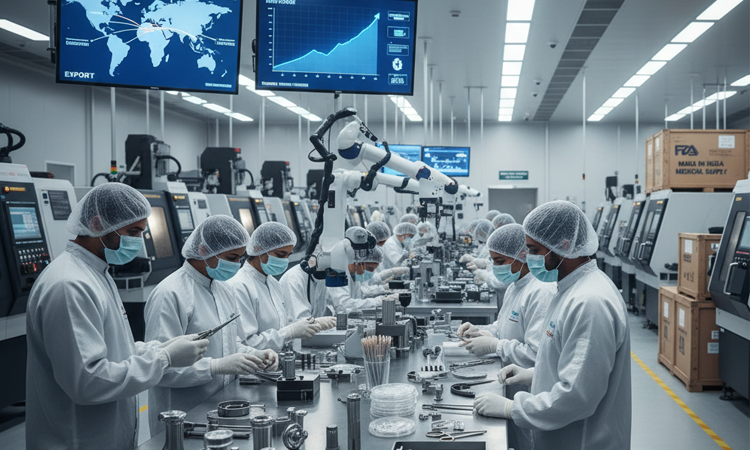
India is quickly becoming a major player in the worldwide market for medical tools and devices. The country has a long history of being good at making drugs, but now it’s using its engineering skills, low costs, and growing technological capabilities to become a reliable and competitive manufacturing hub for a wide range of medical parts, implants, and micro tools, mostly for export markets. This change in strategy is not only helping India’s economy expand, but it is also making global medical supply chains more resilient and diverse.
The Foundation: Engineering Talent and Cost-Effectiveness
One of India’s best features is that it can make things cheaply. India is a good place to outsource since it can create high-quality medical gadgets and parts for less money than Western countries. Along with this, there is a large pool of skilled engineers and technicians who are experts in precision manufacturing, materials science, and quality control. These are all necessary for the strict standards of the medical business. Many Indian businesses have also spent a lot of money training their workers to meet global standards.
Adding more products to the line: from parts to complicated tools
At first, India’s role in medical supply chains may have been limited to making smaller parts or to contract manufacturing. However, there has been a clear rise in the complexity and sophistication of the goods being sent abroad:
Precision Components: Indian companies are doing a great job of making high-precision machined parts for bigger medical equipment, like casings, connectors, and internal mechanics.
Orthopedic Implants: The knowledge of metallurgy and improved manufacturing methods is making it possible to make a wide range of orthopedic implants, like hip and knee replacements, spinal fixation devices, and trauma plates, that are often made to order for specific market needs.
Surgical Instruments: Indian companies make a wide range of surgical instruments, from general equipment to very specialized ones for minimally invasive surgery. This includes small tools for eye, brain, and heart surgeries that benefit from the advances in micromachining technology that were talked about earlier.
Stents and Catheters: India is making more and more complicated medical devices including cardiovascular stents, urological stents, and different types of catheters because it is getting better at precision forming, laser cutting, and surface finishing.
Global Certifications and Quality Compliance
India must follow international quality standards in order to become a trusted global supplier. Indian companies that make medical devices are working hard to get certifications like these:
ISO 13485 is the worldwide standard for medical device quality management systems.
CE Marking: Required for marketing goods in the European Economic Area.
FDA Compliance: A lot of businesses are establishing facilities and processes to meet the strict standards set by the U.S. Food and Drug Administration. This will let them enter the profitable North American market.
This promise of quality makes sure that medical gadgets created in India are not only affordable, but also fulfill the stringent safety and performance standards set by healthcare professionals around the world.
Support from the government and the future
The “Make in India” program and the Production Linked Incentive (PLI) schemes for medical equipment are two examples of government programs that are giving things a big boost. These rules boost manufacturing in the country, promote new ideas, and bring in foreign investment in the sector. Also, the focus on building dedicated Medical Device Parks is meant to establish environments that make it easier for people to work together, share resources, and learn new skills.
India is poised to step in and fill the gap as global supply chains look for more resilience and diversity after the pandemic. With its skilled workers, innovative production capabilities, reasonable prices, and strong dedication to quality, it is well-positioned to play an increasingly important and necessary role in the global supply of medical equipment and parts. This path shows how India has changed from being a regional participant to a true global manufacturing powerhouse in the field of medical technology.
