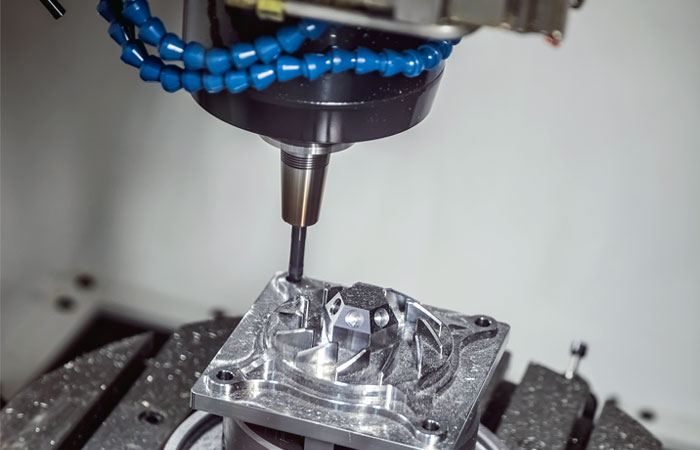
The die and mould tooling sector is undergoing a quiet but powerful transformation. What was once considered a traditional, craftsmanship-driven industry is now evolving into a technology-intensive ecosystem where digital engineering, automation, advanced materials, and hybrid manufacturing methods are redefining how tools are designed, produced, and maintained. Across the world, toolmakers are balancing speed, precision, cost efficiency, and sustainability — all while supporting industries that demand faster product development cycles than ever before.
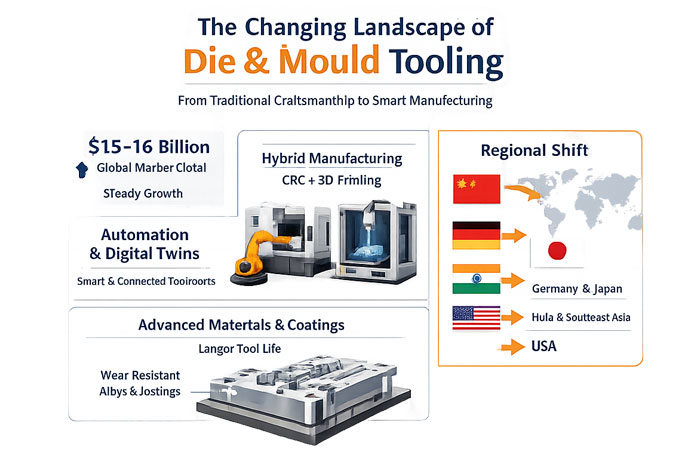
Today, the global die and mould tooling industry is valued at roughly USD 15–16 billion, with steady annual growth expected over the next decade. Demand continues to come primarily from automotive, consumer electronics, packaging, aerospace, and medical manufacturing, where precision tooling is essential for mass production and quality consistency.
What is changing is not just the scale of demand — but the way tooling is being produced.
Hybrid manufacturing becomes the new normal
One of the most significant developments in die-mould tooling is the growing adoption of hybrid manufacturing, combining high-precision CNC machining with additive manufacturing (3D printing). Toolmakers are increasingly using metal additive manufacturing to create conformal cooling channels in injection moulds, something that was difficult or impossible using conventional machining.
This approach improves heat dissipation, reduces cycle times, and enhances part quality. In high-volume plastic injection moulding, even a small reduction in cooling time can translate into substantial productivity gains. As a result, additive manufacturing is no longer seen as experimental — it is becoming a practical productivity tool for modern toolrooms.
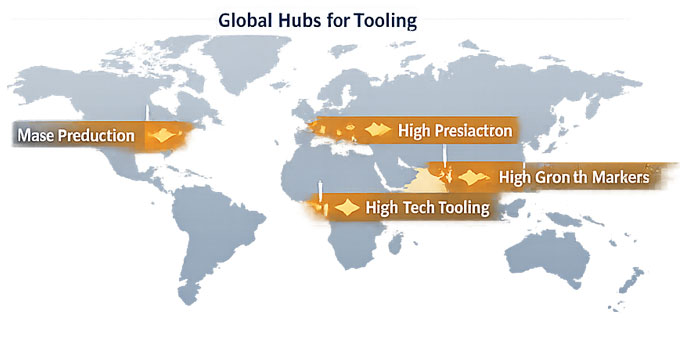
Hybrid production strategies are particularly visible in advanced tooling hubs in Germany, Japan, and the United States, where technology adoption cycles are shorter and customers demand higher performance tools.
Automation and digitalization in toolrooms
Another clear trend is the automation of toolmaking operations. Palletized machining centers, robotic electrode handling, automated EDM cells, and integrated inspection systems are becoming more common in modern toolrooms.
Digital technologies are also changing the way tools are designed and validated. Simulation-based design and digital twins allow engineers to predict tool wear, stress distribution, and forming behavior before the tool is manufactured. This reduces trial-and-error iterations and improves first-time-right manufacturing.
For toolmakers, this means moving beyond machining expertise into software-driven engineering capabilities. Skilled programmers, CAD/CAE specialists, and metrology engineers are becoming as important as machinists in advanced toolmaking environments.

Materials and coatings extending tool life
Material innovation is another area reshaping die and mould tooling. Advanced tool steels, powder-metallurgy materials, and high-performance coatings are extending tool life while maintaining dimensional stability under demanding production conditions.
Surface coatings such as PVD and CVD are widely used to improve wear resistance, reduce friction, and enhance release properties in moulding and stamping applications. Combined with optimized cooling strategies, these material improvements help manufacturers achieve longer production runs with fewer maintenance interruptions.
This is particularly important for industries like automotive stamping, electronics connectors, and packaging moulds, where tools must withstand continuous production cycles.
Regional manufacturing shifts
Global supply chains in die and mould tooling are becoming more regionalized. While China remains the largest producer and exporter of moulds and dies, other countries are strengthening their positions to serve local manufacturing ecosystems.
Germany continues to lead in high-precision tooling and engineering expertise, especially for automotive and aerospace applications. German toolrooms are known for automation, process integration, and advanced machining technologies.
Japan maintains strong capabilities in micro-precision moulds used in electronics, optics, and semiconductor-related components. Japanese tooling companies are highly respected for accuracy and reliability.
India, meanwhile, is emerging as one of the fastest-growing tooling markets. Expansion in automotive manufacturing, consumer appliances, and packaging is driving strong demand for domestic toolmaking capabilities. Improvements in metrology infrastructure, CAD/CAM adoption, and skilled manpower are strengthening India’s position as a global tooling partner.
Vietnam, Thailand, and Indonesia are also becoming important regional suppliers as electronics and consumer-goods manufacturing expands across Southeast Asia.
In the United States, tooling activity is increasingly focused on high-value applications such as aerospace, medical devices, and electric vehicle components, where automation and precision justify higher tooling costs.
Shorter product lifecycles driving tooling demand
Another major factor influencing die-mould tooling is the shortening lifecycle of manufactured products. Consumer electronics, electric vehicles, and packaging designs change more frequently than before, requiring faster tooling development and modification cycles.
This shift is pushing toolmakers to adopt modular tooling concepts, rapid prototyping, and simulation-based validation to reduce lead times. Customers now expect toolmakers to function as engineering partners, not just suppliers.
Toolrooms that can deliver design optimization, process validation, and production support are gaining competitive advantage.
Sustainability enters the tooling conversation
Sustainability is becoming an important theme in tooling as well. Energy-efficient machining, optimized cooling designs, and longer-lasting tool materials all contribute to reducing manufacturing waste and energy consumption.
Additive manufacturing also supports sustainability by minimizing material removal and enabling efficient tool geometries.
Large OEMs are increasingly evaluating tooling suppliers not only on cost and quality, but also on process efficiency and environmental responsibility.
The road ahead
The die and mould tooling industry is moving toward a future where precision engineering meets digital manufacturing intelligence. Technology adoption will determine competitiveness more than scale alone.
China will likely remain dominant in volume production tooling, while Germany and Japan continue leading in engineering excellence. India and Southeast Asia will grow as flexible and cost-effective tooling hubs. The United States will remain strong in high-value tooling segments.
Across all regions, one reality is clear: toolmaking is becoming smarter, faster, and more collaborative.
The modern die-mould toolmaker is no longer defined only by machining capability, but by the ability to integrate design, materials, automation, simulation, and manufacturing knowledge into a single solution.
As manufacturing industries continue to evolve, die and mould tooling will remain the foundation that enables innovation — shaping everything from automobiles and medical devices to electronics and packaging products used every day.
And in this transformation, the toolroom is no longer just a support function — it is becoming a strategic driver of manufacturing competitiveness.