


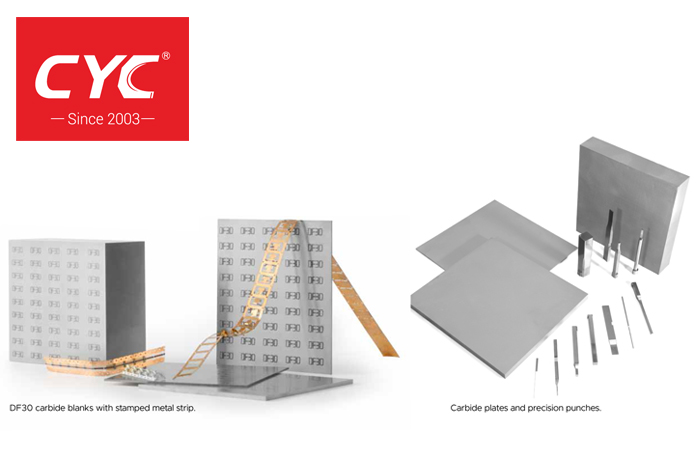
CY Carbide (CYC) supplies cemented carbide plates that toolmakers machine into punches and dies for stamping semiconductor lead frames, connector terminals and metal components for LEDs. Hardness is one consideration. When a punch comes out of the press, its cutting edge shows which property to prioritise. A rounded edge points to gradual wear. A missing corner suggests the tool needs greater toughness. Metal adhering to the punch face calls for a grade that resists pickup from the strip.
Semiconductor Lead Frames
A semiconductor lead frame has a series of fine metal leads. The punch must reproduce those features stroke after stroke. As the cutting edge wears, burrs on the stamped part can grow until the punch needs regrinding. This makes the number of strokes to the first regrind a useful measure for toolmakers who need to plan maintenance around a production run.
CYC recommends MH15 for high-speed lead frame dies where gradual wear determines the regrind interval. Its tungsten carbide grains measure less than one micrometre. This fine structure helps toolmakers machine a sharp edge with little chipping, while the grade’s wear resistance helps the punch retain that edge in service. In a comparison on 0.5 mm stainless steel, an MH15 punch reached 109,000 strokes before its first regrind. A punch made from an imported grade reached 99,000 strokes. When comparing grades this way, use the same burr limit to trigger both regrinds.
CYC’s advanced tungsten carbide grades—MH15, DF20, DF30 and DM40—deliver exceptional wear resistance, edge retention and resistance to chipping, cracking and metal adhesion. Designed for semiconductor lead frames, connector terminals and LED components, these precision materials help extend punch life, reduce regrinding frequency and improve production reliability in demanding high-speed stamping applications.
Connector Terminals
In high-speed connector terminal stamping, repeated impact can cause a punch to crack or shed a small fragment while the rest of the cutting edge is still sharp. CYC recommends DF20 and DF30 for connector terminal and battery tab dies subject to these loads. Both grades combine fine tungsten carbide grains with a controlled cobalt binder content to resist cracking and spalling.
In one high-speed stamping application on 0.5 mm copper strip, CYC reports an average service life of 8.17 million strokes for DF30 punches. A shop evaluating a grade on its own press can record the stroke count at each regrind and again at final replacement. Recording why the punch was removed also helps distinguish a planned stop for sharpening from a tool change caused by a chipped edge.
LED Components
For some LED component dies, the first sign of trouble is a deposit on the punch face. Pure iron, for example, can adhere to the tool during stamping. CYC recommends DM40 when metal pickup limits die life. The grade uses a lower cobalt content and a modified carbide grain structure to reduce adhesion between the workpiece and the binder. DM40 also resists corrosion and is well suited to electrical discharge machining (EDM).
CYC has developed hard materials for more than 20 years. It makes its carbide plates in-house using cold isostatic pressing and sinter-HIP, with batch traceability from raw powder to sintered blank. For a grade recommendation, share the strip material, thickness and stamping speed with CYC. A close-up of the used punch, alongside a sample of the stamped part, can help identify what finally took the tool out of service.
Visit: www.cycarbide.com
