To transition from general machining to the elite tier of aerospace exports, an Indian cutting tool manufacturer must move beyond basic ISO 9001 standards. In the aerospace world, certification is not just a badge—it is a license to operate.
The two pillars of this compliance are AS9100 (the system) and Nadcap (the process).
As9100 Rev D: The Quality Management Foundation
While ISO 9001 focuses on general quality, AS9100 Rev D adds 55 aerospace-specific requirements. It is a prerequisite for almost every global aerospace OEM (Airbus, Boeing, GE).
- Risk Management: You must prove a formal process for identifying and mitigating risks across the tool’s lifecycle (e.g., what happens if a batch of carbide is slightly brittle?).
- Product Safety & Counterfeit Prevention: Includes rigorous checks to ensure raw materials (tungsten/cobalt) are not from unverified or “black market” sources.
- Configuration Management: Every tool must be traceable. If a turbine blade fails in five years, the OEM must be able to trace it back to the specific batch of tools used to cut it.
Nadcap: The Special Process Standard
Nadcap (National Aerospace and Defense Contractors Accreditation Program) is different. While AS9100 audits your management, Nadcap audits your technical execution.
For a cutting tool manufacturer, Nadcap is essential if you perform these “Special Processes” in-house:
- Coatings (CT): Audits for PVD/CVD coating thickness, adhesion, and consistency.
- Heat Treatment (HT): Essential if you are hardening high-speed steel (HSS) or treating tool shanks. It requires AMS 2750 compliance (Pyrometry) to ensure furnace temperatures are precise to within a few degrees.
- Chemical Processing: Necessary if you use acid etching or chemical cleaning for tool surface preparation.
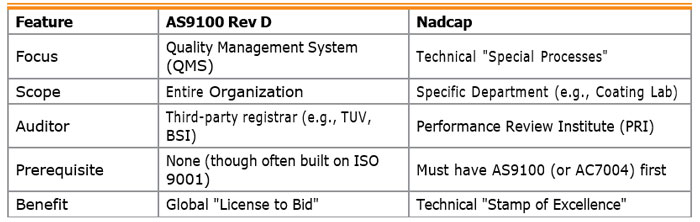
AS9100 vs. Nadcap: A Strategic Comparison
Tooling-Specific Standards
Beyond certifications, aerospace exporters must adhere to rigid technical standards that define tool geometry and performance:
- ISO 13399: The international standard for the computer-interpretable representation and exchange of industrial product data for cutting tools. This allows your tools to “talk” to the client’s CAM software seamlessly.
- MBD (Model-Based Definition): Modern aerospace clients expect 3D models of tools with embedded PMI (Product Manufacturing Information). You aren’t just shipping a tool; you are shipping a “Digital Twin.”
The “Export-Ready” Roadmap For 2026
- Gap Analysis: Transition from ISO 9001 to AS9100 Rev D. Focus on clause 8.1.1 (Operational Risk).
- Digital Traceability: Implement an ERP system that handles batch-level tracking of raw carbide and coatings.
- Process Control: If you provide high- performance coatings, start the Nadcap “Coatings” accreditation process—it typically takes 9–12 months.