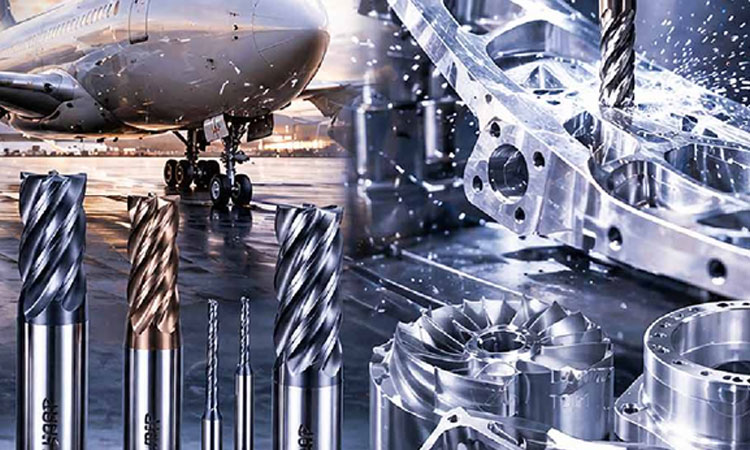
The story of the Indian cutting tool industry in 2026 is one of a dramatic “leapfrog.” While rising tungsten prices initially threatened the sector, a surge in global aerospace demand—projected to require over 40,000 new aircraft by 2040—has created a vacuum that Indian manufacturers are uniquely positioned to fill.
The Precision Pivot: From Commodity To Complexity
The opportunity for India lies in the transition from commodity tooling to application-specific engineering. Aerospace components involve “difficult-to-cut” materials: Titanium alloys, Heat- Resistant Super Alloys (HRSA), and Carbon Fiber Reinforced Polymers (CFRP). These materials don’t just require a tool; they require a metallurgical masterstroke.
Vikram’s company moved away from generic catalogs. Instead, they invested in 5-axis CNC grinding centers and PVD (Physical Vapor Deposition) coating technology. By developing specialized tool geometries that reduce “heat- affected zones” during the machining of turbine blades, they didn’t just lower the cost—they increased the fatigue life of the engine parts themselves. In the aerospace world, where a single micron of deviation can mean mission failure, this precision is India’s new currency.
The “China Plus One” Tailwind
Geopolitical shifts have turned India into a strategic “China Plus One” partner for global aerospace giants like Airbus, Boeing, and GE. These OEMs (Original Equipment Manufacturers) are aggressively looking for localized tool supply chains to mitigate risk.
However, entering this “Premier League” of manufacturing requires more than just a good product. For an Indian manufacturer, an export contract is a digital commitment.
“Exporting to the EU and US forced us to digitize,” Vikram explained. “Every tool we export now has a laser-etched QR code. A technician in Seattle can scan it and see the exact batch of recycled carbide it was made from, its coating thickness, and its predicted tool life.” This level of AS9100 certification and digital traceability has moved Indian firms from being “vendors” to “strategic partners.”
The Circular Edge: Sustainability As A Sales Tool
Perhaps the biggest competitive advantage for Indian exporters has been the integration of recycling into the export model. By offering “Closed-Loop” contracts to international clients— where spent tools are shipped back to India for reclaiming—Indian firms are offering a lower carbon footprint than their global competitors. In a world of tightening ESG (Environmental, Social, and Governance) norms, a “Green Tool” is often the tie-breaker in a multi-million dollar tender. Using the Zinc Recovery Process, Indian firms are reclaiming high-purity tungsten from scrap, reducing energy consumption by 70% and ensuring that the high cost of raw materials doesn’t grounded their export ambitions.
Carving The Future
As Vikram watched the turbine housing being crated for shipment, he knew the window of opportunity was wide open. With a domestic defense boom and a surging global civil aviation market, India’s cutting tool manufacturers are no longer just followers of global standards. They are the ones carving out the future of flight, one micron at a time.
The “Made in India” label on a high- performance end mill is no longer just a mark of origin—it is a mark of global excellence.