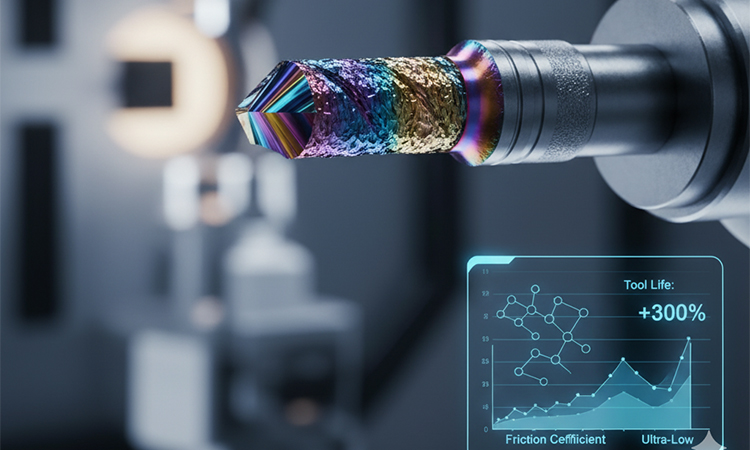
To make complicated medical devices like micro-stents, orthopedic screws, and laparoscopic instruments, you need cutting tools that are very precise, last a long time, and are completely biocompatible. Traditional tools often break when they are used to machine hard, bio-friendly materials like titanium, stainless steel, and cobalt-chromium alloys. This causes too much wear and poor part quality. Advanced thin-film coatings are the answer. They turn little tools into high-performance parts, greatly increasing their lifespan while keeping the tightest tolerances.
New things in PVD and CVD: The Main Technology The main ways to use these films are Chemical Vapor Deposition (CVD) and Physical Vapor Deposition (PVD).
Recent improvements to these procedures are made to fit the small shapes of medical micro tools:
PVD (Physical Vapor Deposition): This method is best for micro-tools because it applies coatings at lower temperatures (around $400–600^\circ C$), which helps keep the tool’s sharp cutting edge and fine shape. Medical production often uses PVD coatings like these: Titanium Nitride (TiN) is a strong, general-purpose coating that resists wear well.
Titanium Aluminum Nitride (TiAlN / AlTiN): This material is great for high-speed machining of hard materials like titanium alloys since it doesn’t oxidize easily and stays stable at high temperatures.
Chromium Nitride (CrN): This material is great for machining materials that are likely to build up edges (BUE) since it resists corrosion well and has minimal friction.
Chemical Vapor Deposition (CVD): CVD is usually utilized for heavier-duty jobs because its coatings are thicker and stickier. However, modern plasma-enhanced CVD (PECVD) technologies are being improved for micro-tool jobs that need very particular material compositions. The Growth of Nano-Coatings and Multilayers
The quest for enhanced performance and increased compliance has propelled coating technology into the nanoscale, yielding two significant advancements:
Nano-Structured Coatings: The grains in these coatings are in the nanometer range. This very tiny structure makes the film much harder and tougher, so tools can cut faster and at greater temperatures without wearing out too soon. Compared to regular coatings, they are more resistant to wear, which makes them essential for the difficult micro-milling of medical parts.
Multilayer Coatings: Engineers construct coatings that take advantage of the synergistic features of each substance by putting two or more materials in alternating, very thin layers (for example, CrN/TiN or TiAlN/TiCN). For example, a strong base layer can help hold things together, and a top layer with low friction can let chips move smoothly and keep heat from building up. This customisation lets tool designers make films that work best with certain medical metals. Biocompatible Champion: Diamond-Like Carbon (DLC) Films
The increased use of Diamond-Like Carbon (DLC) films is one of the most important improvements in medical tool coating. DLC is a film made of amorphous carbon that has many of the same good qualities as genuine diamond. Very hard and resistant to wear: this makes pricey micro-tools last longer. Ultra-
Low Coefficient of Friction: DLC’s great lubricity lowers heat, stops the work material from sticking to the cutting edge (known as BUE), and gives the finished medical item a better, cleaner surface quality, which is very important for accuracy and function.
Biocompatibility: Pure DLC films are very chemically stable and have shown to be quite biocompatible, which is a must for surgical instruments, drill bits used in bone, and implants. This inertness also helps the instruments handle the extreme chemical and thermal strains that come with repeated sterilizing cycles (like autoclaving). By combining these sophisticated PVD, CVD, and customized nano- and DLC films, tool makers can give the small-scale power and reliable performance that modern medical device manufacturing needs to satisfy its ever-increasing standards.