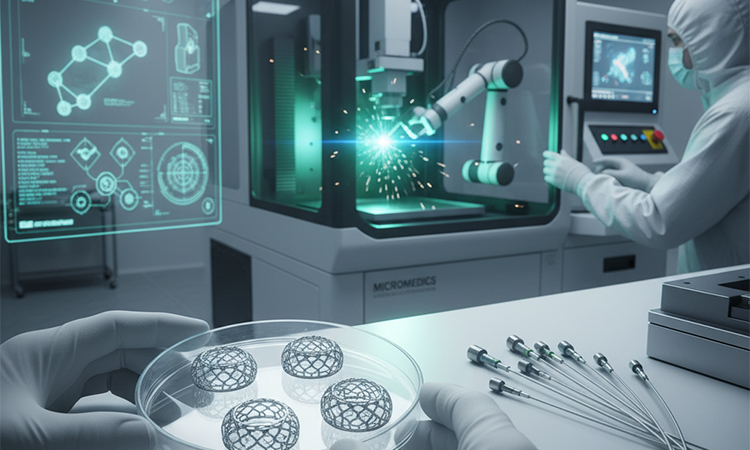
Exactness on a Small Scale
Micromachining is the process of making parts and features that are usually in the micrometer range (one millionth of a meter) or even smaller. This level of accuracy is very important for medical devices since even small changes can affect how well they work, how safe they are for patients, or how well they work with the body. It’s hard for traditional machining technologies to make these tiny parts with the right tolerances or the complicated shapes they need.
Making it possible to have small implants and stents
Micromachining has had a big effect on the creation of implants. Cardiovascular stents, which are very important for treating clogged arteries, have gotten more complicated. Micromachining makes it possible to make very thin stent struts with complicated designs that improve flexibility, drug elution, and long-term patency. Neurological implants, like those used for deep brain stimulation, also need electrodes and connectors that are very thin and fashioned just right so they may connect to sensitive neural tissues without hurting them.
Micromachining is used to make additional small implants, such as micro-pumps for drug delivery, retinal implants, and cochlear implants, as well as stents. Advanced micromachining techniques are needed to make the tiny channels, holes, and complex surface patterns that are commonly found on these devices.
The Growth of Surgical Tools
The search for minimally invasive surgery (MIS) has greatly raised the need for surgical tools that are smaller and easier to handle. Micromachining is important for making these instruments because it lets for:
- Small Jaws and Grippers: Instruments typically have to work through very small cuts during endoscopic and laparoscopic procedures. Micromachining makes the small, complex jaws, scissors, and graspers that give surgeons more control than ever before in tight areas.
- Precision Needles and Catheters: The tips of biopsy needles, drug delivery catheters, and ablation probes can be micromachined to make them exceedingly sharp, have precise bevels, or have complicated multi-lumen designs that make them work better and hurt less tissue.
- Integrated Sensors: Micromachining makes it possible to put tiny sensors onto instrument tips, which give the surgeon real-time information about things like temperature, pressure, and electrical activity during complicated procedures.
Advanced Micromachining Methods
This revolution is being led by a few important micromachining technologies:
- Laser Micromachining: Highly focused lasers can cut, drill, engrave, and ablate materials with high precision, making them great for producing detailed designs on stents or drilling tiny holes.
- Electrical Discharge Machining (EDM): Micro-EDM works best on hard, conductive materials and can make complicated 3D shapes and very fine details that would be hard to make with other technologies.
- Micro-Milling and Micro-Turning: Ultra-precision machine platforms with specialized micro-tools can make tiny parts with very tight tolerances and smooth surfaces.
- Additive Manufacturing (Micro 3D Printing): New micro-AM methods are making it possible to make very complex, one-of-a-kind micro-structures and lattices that can be designed to work with certain biological interactions.
The Future is Small and Exact
We should expect medical gadgets to get even better and smaller as micromachining technology continue to improve. This not only promises better outcomes for patients by using less invasive procedures and more effective therapies, but it also offers up new ways to diagnose and cure problems. Being able to work on a small scale is no longer a special skill; it’s now a basic prerequisite for modern medicine to be innovative.