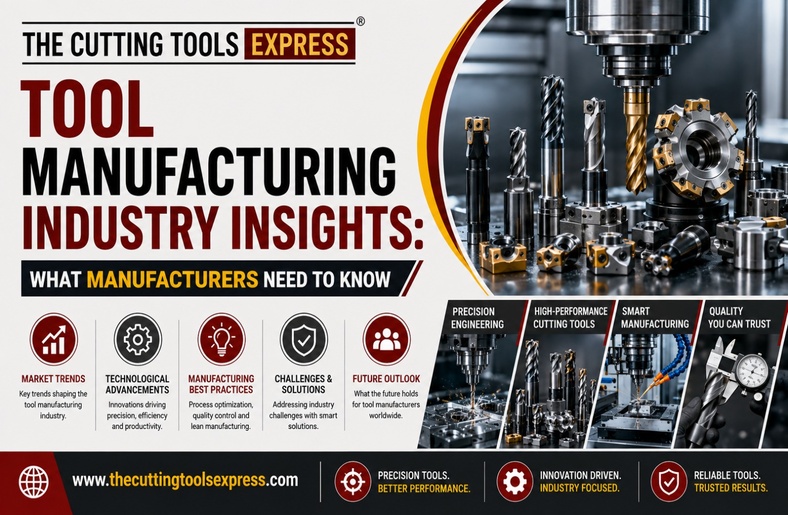
Manufacturers have a lot to deal with in 2026. Parts need to be made faster, sizes have to be more accurate, and production costs cannot keep going up. Even the materials being machined are getting harder in many cases.
This is where tooling comes into the picture. A small change in the cutting tool can affect the whole machining job, from tool life and speed to surface finish and part quality. That is why tool manufacturing industry insights are useful for anyone involved in manufacturing.
The Cutting Tools Express follows cutting tools, machining technology, and other tool manufacturing developments. In this article, we look at what is changing, what is driving demand, and where Indian manufacturers may find new opportunities.
What is the Current State of the Tool Manufacturing Industry?
The tool manufacturing industry supports the wider manufacturing sector by producing equipment used to cut, form, shape, and finish components. It includes cutting tools, dies and moulds, forming tools, precision tooling, and special-purpose tools made for particular jobs.
Cutting tools are used for operations such as turning, milling and drilling. Dies and moulds create repeatable shapes, while forming tools shape material without removing it in the same way as a cutting operation. Precision and special-purpose tools are made where standard products cannot meet a particular requirement.
In India, demand is closely tied to automotive, aerospace, defence, electronics, medical and general engineering. The country’s machine-tool industry recorded production of about ₹16,478 crore in FY 2025-26, according to IMTMA.
This points to a growing market for better and more capable tooling.
Key Trends Shaping Tool Manufacturing in 2026
High-Performance Tool Materials
Carbide continues to be an important material for modern cutting tools because it can handle high cutting speeds while offering good wear resistance.
Other materials, including cBN or PCBN, PCD and ceramics, have their own place when the job involves hardened steel, composites, non-ferrous materials or high cutting temperatures.
Advanced Coatings and Tool Geometries
Coatings such as PVD and CVD have become an important part of tool development. They can improve resistance to heat and wear and help the cutting edge survive demanding conditions.
Tool shape is receiving similar attention. Flute design, edge preparation, rake angle and chip control can all be changed for a particular material or operation.
Automation and Smart Tooling
CNC machining has changed how tools are used and managed. Today, operators can monitor tool wear and machine conditions during production. This helps them find problems early and avoid producing faulty parts.
Smart manufacturing was a major focus at IMTEX 2025, where exhibitors showcased CNC systems, automation, robotics, tooling, metrology, and digital manufacturing solutions.
How Digital Technology Is Transforming Tool Manufacturing
Tool development used to involve a fair amount of physical testing and adjustment. Digital engineering is reducing some of that work.
- CAD/CAM systems allow engineers to design tools and prepare machining data before production starts.
- Simulation can help identify clearance, collision, toolpath, and other problems before they become shop-floor problems.
- CNC tool grinding and 5-axis machining have also made complex tool production more manageable.
- On the inspection side, CMMs, scanning equipment, and automated measurement systems help check tool geometry and dimensions with greater consistency.
- Digital methods can reduce trial-and-error, rework, scrap, and development time. They also create a better base for automated production.
For Indian manufacturers, this is a key competitive point. Better digital processes can help companies compete through accuracy and consistency rather than competing only on price.
What Is Driving Demand for Advanced Manufacturing Tools?
Different manufacturing industries are pushing this demand in their own ways:
Automotive
Car makers need tools that can support large production runs without frequent tool changes. EVs are also creating demand for tools used to make battery parts, motor components, gears, and lighter vehicle parts.
Aerospace & Defence
Aerospace & defence parts use tough materials that are harder to machine. Manufacturers need reliable tools that can handle these materials while keeping the required size, shape, and finish.
Electronics & Semiconductor Manufacturing
Electronic parts are getting smaller, leaving less room for machining errors. This is increasing the need for specialised tools that can make small features accurately and deliver a clean finish.
Medical and General Engineering
Medical and engineering products need accurate parts that can be made the same way every time. This creates demand for tools that offer good finish, performance, and longer service life.
What Are the Major Challenges Facing Tool Manufacturers in India?
Rising Raw-Material Costs
Tool manufacturers have to manage the cost of carbide, steel, cobalt, ceramics, and other materials. Price changes can quickly affect production costs, particularly for smaller companies.
Import Dependence
Some key raw materials, parts, coatings, and specialised equipment still come from overseas suppliers. This can leave manufacturers dealing with currency changes, shipping delays, and supply problems.
Cost and Price Pressure
Customers want better tool life and performance but still expect competitive prices. Toolmakers have to improve manufacturing efficiency without cutting corners on quality.
Skill Gaps
Advanced CNC systems, inspection systems, and digital software require trained workers. Finding and retaining people with the right technical skills remains a challenge.
Technology Investment
New grinding machines, inspection systems, software, and automation equipment require considerable investment. Smaller companies may find it difficult to upgrade everything at once.
Conclusion
Tool manufacturing is changing along with the factories that depend on it.
Better materials, coatings, digital design, CNC grinding and process monitoring are now literally in high demand because they give manufacturers more ways to improve machining results.
India has a strong opportunity, but success will depend on skills, local supply chains and continued investment in technology.
As these changes continue, The Cutting Tools Express will remain a useful source for keeping up with machining technologies, industry developments and practical cutting-tool insights.
Frequently Asked Questions (FAQs)
Q1. What is the tool manufacturing industry?
- The tool manufacturing industry makes cutting, forming, precision, and special-purpose tools used to produce parts for automotive, aerospace, electronics, medical, and other industries.
Q2. What are the major trends in tool manufacturing?
- Major trends include better tool materials, advanced coatings, CNC machining, automation, digital design, tool monitoring, and greater use of specialised tooling for difficult materials.
Q3. What challenges does the Indian tool manufacturing industry face?
A. Key challenges include rising material costs, import dependence, price pressure, limited skilled workers, and the high cost of investing in new machines and technology.