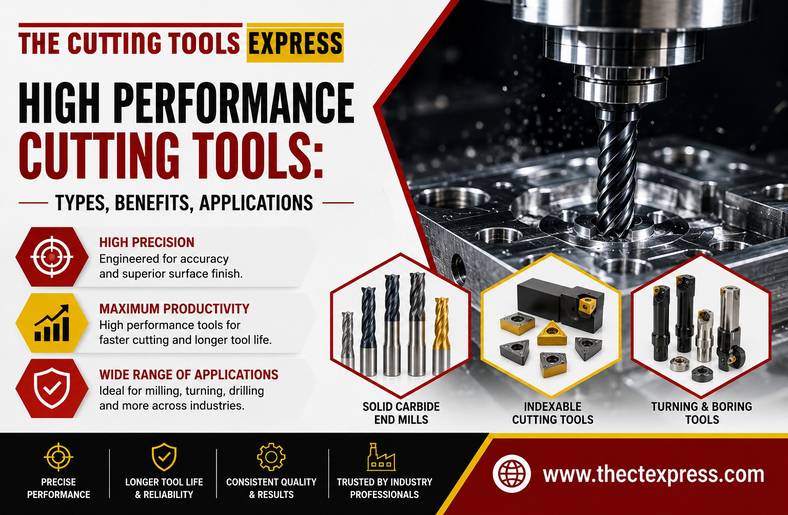
If you’re in the cutting tool industry, you might have known that choosing the right tool can make a good difference in machining performance. That’s what The Cutting Tools Express offers, a useful information on tools and machining practices to help manufacturers make better tooling decisions.
The “High Performance Cutting Tools” remove material from a workpiece and help turn raw metal into accurate parts with the required shape and finish. They are made for demanding machining work where higher speeds, longer tool life, and consistent results are important.
Let’s learn what high performance cutting tools are, types, benefits, and applications.
What Are High Performance Cutting Tools?
High performance cutting tools are advanced industrial tools that are built specifically to shape tough metals with extreme accuracy.
They are usually made from wear-resistant materials and may have special geometries or coatings that help them deal with heat, friction, and cutting forces.
Some common characteristics include:
- Higher cutting speeds: They can support faster machining.
- Better wear resistance: The edge that cut can remain usable for longer before noticeable wear develops.
- Longer tool life: There are fewer replacements that can be needed during a production run.
- Improved dimensional accuracy: Better edge stability helps maintain the required part dimensions.
- Better tool stability: It helps maintain consistent dimensions and tight tolerances.
- Better heat resistance: Certain tool materials can withstand the high temperatures produced during cutting.
These tools are also useful for difficult materials, including “hardened steels”, “superalloys”, “composites”, and other materials that create high cutting forces or heat.
Tool material is a major part of this performance. Carbide is widely used for general machining, while ceramic, cermet, PCD, diamond, and CBN are selected for particular materials and operations. Coatings can also protect the tool and improve how it performs.
Types of High Performance Cutting Tools
Some of the main types of high performance cutting tools include the following.
Carbide Cutting Tools
Carbide tools are widely used because they offer a useful balance of hardness, toughness, and wear resistance. They can operate at higher speeds than traditional high-speed steel tools.
Carbide is available in many forms, including “drills”, “end mills”, “inserts”, and “reamers”. Depending on the grade and design, these tools can be used on steel, cast iron, etc.
Ceramic Cutting Tools
Ceramic cutting tools can handle very high temperatures, making them suitable for certain high-speed machining jobs. They are often used when machining hard materials or when high cutting speeds are required.
Their main limitation is brittleness. Ceramic tools need a stable machine setup and are less suitable for heavy interrupted cuts or operations with excessive vibration.
Cermet Cutting Tools
Cermet tools combine ceramic particles with a metallic binder. They are known for good hardness and wear resistance and are often chosen for finishing work.
When used under suitable conditions, cermet tools can produce a good surface finish and maintain consistent cutting performance. They are particularly useful when surface quality is more important than heavy material removal.
Diamond and PCD Tools
Diamond is one of the hardest materials used for cutting applications. PCD, or polycrystalline diamond, is commonly used for non-ferrous metals, composites, and other abrasive materials.
These tools can retain their cutting edge for a long time when used correctly. Their wear resistance makes them useful for accurate machining where surface quality and repeatability matter.
CBN Cutting Tools
CBN, (or cubic boron nitride), is mainly used for hard machining. It is suitable for hardened steels, cast iron, and other materials that can cause rapid wear in conventional tools.
CBN offers good resistance to heat and wear, which makes it useful for hard turning and other operations where maintaining the cutting edge is difficult.
How Tool Coatings Improve Performance
Coatings are applied to many cutting tools to give the cutting edge additional protection. They can reduce friction, limit wear, and help the tool deal with heat generated during machining.
- TiN (Titanium Nitride) is a widely used coating that gives good hardness and wear resistance for multiple machining applications.
- TiAlN and AlTiN coatings are suitable for applications that generate high levels of heat. Their resistance to high temperatures can make them useful for high-speed machining and difficult materials.
- DLC (Diamond-Like Carbon) coatings have low friction and good wear resistance. They can be useful when machining aluminum and other non-ferrous materials where material can stick to the cutting edge.
Note: Keep in mind that a coating that works well for one use may not be suitable for another.
What Are the Uses of High Performance Cutting Tools (H3)
High-performance cutting tools are used in industries, such as:
- Aerospace: Aerospace parts are commonly made from “titanium” or “nickel-based alloys”, which can be hard to machine. So cutting tools need to handle high heat and resist wear.
- Automotive: Cutting tools are used to produce engine components, transmission parts, brake components, and other precision parts. Longer tool life is particularly useful in high-volume production.
- Medical: Medical components often require accurate dimensions and smooth surfaces. Small cutting tools are used to produce implants, instruments, and other precision parts.
- Die and mould manufacturing: This industry often involves hardened steels and complex shapes. Suitable tools help manufacturers produce accurate profiles and surface finishes.
- General engineering: High-performance tools are also used for shafts, housings, machine components, and other industrial parts where reliable machining is needed.
Conclusion
Overall, “high-performance cutting tools” can indeed help manufacturers in improving machining speed, product accuracy, surface finish, and tool life.
But, the main thing is to choose the right one, which depends on the workpiece, machining method, machine, cutting conditions, and production needs. Having a suitable tool can reduce interruptions. Plus, it help manufacturers produce consistent parts more efficiently.
If you want to learn more cutting tools information, industry insights, expert guidances, The Cutting Tools Express covers topics related to modern machining and tooling.
FAQs
Q1. What makes a cutting tool high performance?
- A high-performance cutting tool is made to shape tough metals, like solid carbide, along with maintaining good cutting speed, wear & heat resistance, tool life, and top accuracy.
Q2. Which material is best for high performance cutting tools?
- Cemented Carbide (“tungsten carbide”) is suitable for many machining applications. But, CBN, PCD, diamond, ceramic, and cermet can be better choices for specific cutting operations.
Q3. How can high performance cutting tools reduce machining costs?
A. They can reduce costs by longer life span, shortening machining cycles, reducing tool changes, limiting downtime, and helping produce accurate parts with less rework.