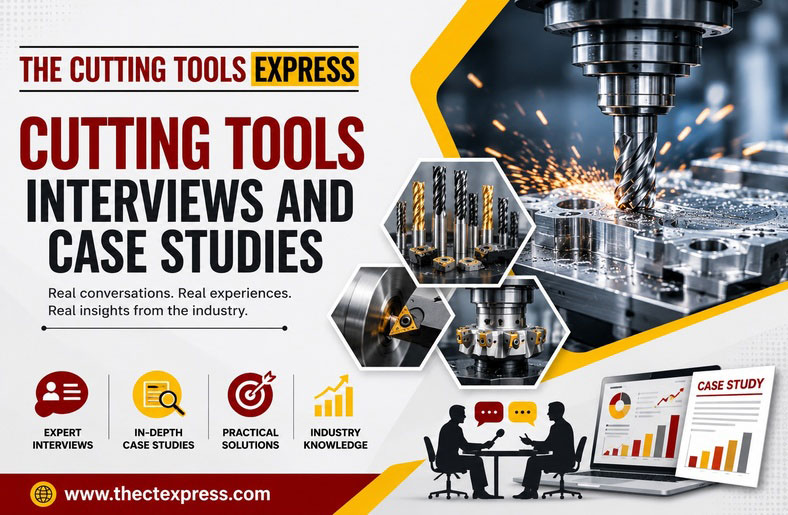
Every “machining project” comes with its own challenges. Sometimes the right cutting tool solves the problem. Other times, the solution involves changing the complete machining process. But, how do we get the understanding of which approach is the right one?
That is why Cutting Tools Interviews and Case Studies are worth reading.
They give you real knowledge that you may not find in textbooks. You also get useful tips from industry experts who work with these challenges every day.
In this article, we’ll learn some real-life case studies, and commonly asked questions in cutting tools interviews. The real examples we’re going to discuss can help you make better decisions and improve your machining process with greater confidence.
Why Cutting Tools Interviews Are Important
Every experienced “machinist” has learned valuable lessons through years of production work. Right? And, when you interview with these professionals, it gives you access to knowledge that cannot always be found in manuals or textbooks.
During “Cutting Tools Interviews”, experts usually discuss how they solve machining problems, select cutting tools, increase tool life, and improve production efficiency.
These conversations provide practical advice that manufacturers can apply in their own workshops. When you understand why a particular tool, insert, or cutting parameter was chosen, it helps you build stronger and real technical knowledge.
Why You Should Read Cutting Tools Case Studies?
Case studies help you know how a problem was solved from start to finish.
Rather than talking about machining in general, case studies focus on real problems, the solutions they used, and the results they achieved.
This makes the information easier to understand and use in similar situations.
A well-written case study usually answers questions such as:
- What problem did the manufacturer face?
- Which cutting tools were selected?
- What changes were made?
- What improvements were achieved?
- What lessons were learned?
This helps manufacturers compare their own production challenges with proven solutions.
Real Life Cutting Tools Case Studies
Case Study 1: Walter AG Helps Cut Machining Time from 5 Hours to 50 Minutes
A German company, “Uwe Krumm Burbach GmbH (UKB)”, faced a major machining challenge while producing large components made from X36CrMo17 hardened steel.
The material was extremely tough, with a strength of up to 1,100 N/mm², and existing cutting tools failed within minutes.
UKB worked with application engineers from Walter AG to review the complete machining process instead of changing only the tool. After testing different insert grades and machining strategies, they developed a solution that transformed production.
The result was impressive. The machining time for each component dropped from “5 hours” to just “50 minutes”. Apart from improving productivity, the company also reduced unnecessary tool wear and made the process much more easy and reliable.
The biggest lesson from this project was simple: difficult materials often require a complete machining strategy, not just a different cutting insert.
Case Study 2: Triple-T Cutting Tools Expands with Better Grinding Technology
“Triple-T Cutting Tools”, based in New Jersey, started as a small custom tooling business in 1995. As customer requirements became more complex, the company needed equipment that could produce precision special tools more efficiently.
Instead of replacing every machine with brand-new models, Triple-T invested in rebuilt WALTER HELITRONIC SL CNC tool grinders equipped with modern CAD/CAM software.
Today, the company works with 17 employees, uses 10 five-axis grinding machines, processes more than 100 cutting tool jobs every month, and has expanded its facility by 5,000 sq feet.
As per the company, advanced grinding software made programming easier, reduced operator training time, and helped build complex tool designs with greater accuracy.
Case Study 3: Jyoti CNC Improves Machine Stiffness Through Simulation
Indian machine tool manufacturer “Jyoti CNC Automation” wanted to make one of its CNC machines stronger without increasing weight or building multiple prototypes either.
To do this, the engineering team used finite element analysis (FEA) and simulation software to test different designs before making the machine.
The results were significant. The redesigned machine achieved an increase of 73% in X-axis stiffness and 64% in Y-axis stiffness while keeping almost the same overall machine mass.
Using simulation also helped engineers identify design issues before production began, reducing both development time and engineering costs.
Common Questions Asked During Cutting Tools Interviews
Here are some common questions you may get asked during cutting tools interviews:
– Which cutting tool material should be selected for a particular machining job?
– What are the most common causes of cutting tool wear?
– Why is tool geometry important in machining?
– How do you choose the right cutting speed and feed rate?
– What is the difference between carbide, HSS, ceramic, and CBN cutting tools?
– How can you improve cutting tool life during production?
– What factors affect surface finish while machining?
– How do you identify and solve problems like chatter or poor chip formation?
– When should a “cutting tool” be replaced instead of reconditioned?
– How do cutting fluids help improve machining performance?
If you know the basics well and can explain your answers with examples, you can answer them with confidence and get your job in the cutting tools industry.
Conclusion
In short, real manufacturing stories always tell you more than theory. Even though technical guides explain the basics, cutting tool case studies show how those ideas are used in real production. They share the problems, the solutions, and the results.
When you give interviews to industry experts, they also share useful tips based on real experience. These insights can help — whether you want to improve tool life or learn new skills.
At The Cutting Tools Express, we also encourage manufacturers, students, and machinists to learn from real industry examples through case studies and interviews.
Frequently Asked Questions (FAQs)
Q1. What are cutting tools interviews?
- In cutting tool interviews, there are discussions with machining professionals where you share your knowledge about the industry challenges and solutions.
Q2. Why are cutting tools case studies important?
- When you learn the case studies, it gives you an idea about how actual machining problems were solved. This makes it easier for you to apply the same ideas in your own work.
Q3. Who should read cutting tools interviews and case studies?
- Anyone who is into the cutting tool industry, be it students, machinists, CNC programmers, production engineers, and manufacturing business owners can all benefit from them.
Q4. What topics are commonly covered during cutting tool interviews?
- In cutting tool interviews, common topics include: tool materials, machining parameters, tool wear, process improvement, CNC machining, and production efficiency.